
AI in Fashion Retail: From Description to Measurement
Apparel is the last major consumer category that still asks the buyer to guess what they are getting. Every other industry has replaced estimation with precise data. The next few years of fashion retail belong to the brands that replace that guess with a measurement.
It is a ubiquitous scene on almost any shop floor. A customer stands holding two sizes of the exact same garment, turning them over in their hands, with no reliable way to choose between them. Alternatively, they look at a size chart that is technically correct on paper but entirely useless in the practical reality of a fitting room.
This uncertainty is treated as an inescapable law of the retail business. It is simply accepted that apparel sizing variance is a problem the shopper has to navigate alone. Brands spend millions on acquiring a customer, only to abandon them at the final hurdle of fit. This is the only category left where the buyer is expected to carry the burden of estimation.
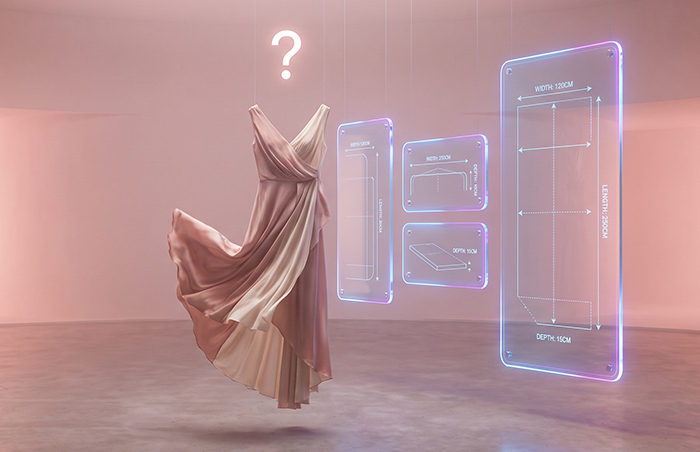
The cost of describing instead of measuring
When you purchase a piece of consumer electronics, the specifications are absolute. A screen has exact dimensions, a defined panel type and a specific refresh rate. When you buy a vehicle, the manufacturer provides definitive performance numbers. Even a mattress sold under a proprietary, branded name still publishes the exact measurements behind that label so the buyer can verify it will physically fit in their home. That is the precise thing the apparel industry refuses to do.
Instead of data, the fashion industry gives you a letter. That letter means one thing at one brand and something entirely different at the next. You are given an evocative fabric name and a stylized photograph of a model who does not share your body type. The consumer is provided with aspirations and descriptions rather than dimensions.
The consequence of this opacity is a structural inefficiency built into the very core of the retail model. When buyers lack reliable data, they over-order to compensate, effectively turning their own bedrooms into fitting rooms. They routinely purchase three sizes of the same shirt and return the two that do not fit. Retailers then absorb the staggering logistical cost of those returns, pricing that vast margin of error into the next season of garments. The entire category operates on a foundation of managed uncertainty. We accept a system where precision is discarded in favour of broad categorisation.
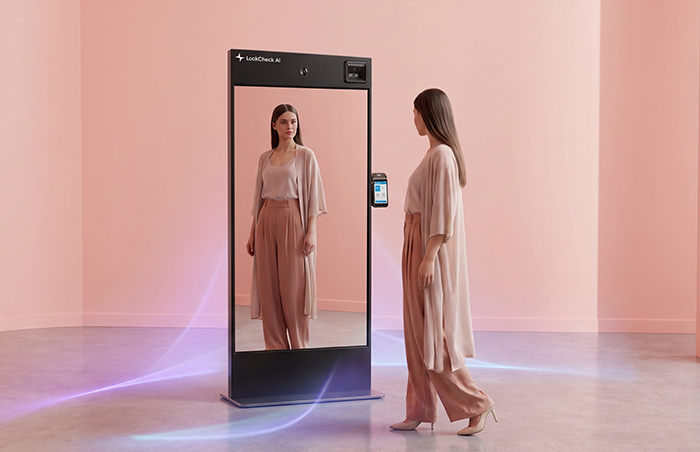
Two engineering problems: visual rendering and spatial measurement
Moving an industry from vague description to mathematical precision involves two different engineering problems, both of which are exceptionally hard. The first problem is primarily visual. Rendering clothing accurately requires the system to hold the fabric drape, texture and pattern correctly on a real, three-dimensional human body. It has to look like a physical garment interacting with gravity, rather than a flat digital sticker overlaid on a photograph.
The second problem is one of spatial measurement. A system has to extract accurate dimensional data from a person who is rarely standing perfectly straight. It must do this on a shop floor that was designed for ambience and never lit for technical photography. This environmental complexity is part of why LookCheck AI smart mirrors capture on a top of the line 4K ultra HD camera rather than a standard lens. It requires hardware capable of cutting through the visual noise of a physical retail space. A mirror needs around 5 feet of clear floor space in front of it for a try-on, ensuring the capture zone is clean.
The capture process on the 55 inch and 65 inch interactive units is methodical. The shopper stands for their height, then follows guided photos. They take a try-on pose, a front-facing shot and a left profile. The second and third images are taken only when the customer wants a size recommendation. When the hardware and software align, the result is definitive. On the smart mirrors, AI size recommendation on garment categories runs to a margin under one inch. This is the difference between a rough estimate and a tailored fit. The shopper can utilise an endless aisle and barcode scan to try-on, taking roughly fifteen seconds to a finished render.

Accuracy needs a number and a defined scope
I have spent more than a decade building systems whose only job was accurate, repeatable measurement. That background teaches you to respect the vast difference between a marketing claim and a verifiable data point. If you cannot quantify the result, you do not have a system.
In retail technology, a vendor who will not put a specific number and a defined scope beside an accuracy claim is asking to be taken on faith. Trusting a software process without a published error rate is not engineering. It is optimism. Rendream publishes an accuracy figure with a strict scope attached because that is what enterprise buyers should expect from the category. We state our margin is under one inch, on garment categories, strictly on the mirrors. Publishing a number with a scope is the position itself.
It proves the technology is grounded in physical reality and rigorous testing. We apply this same strict discipline to our security infrastructure. We encrypt, process and delete all captured images, maintaining our ISO 27001:2022 certification. Nothing is stored on our servers and nothing is used to train generative models. This operational discipline is what separates a novelty application from a piece of core retail infrastructure. When you treat the shopper's data with absolute cryptographic respect, they are willing to engage with the measurement system.
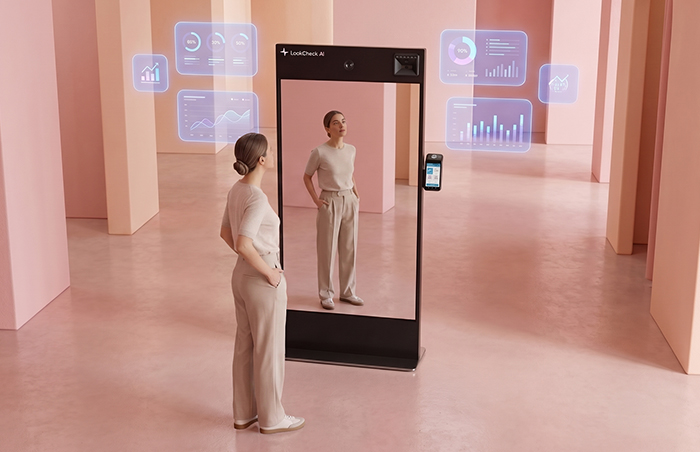
Turning the shop floor into a measurable environment
Ecommerce has meticulously measured everything for twenty years. A digital storefront tracks every click, every hover duration and every abandoned cart. It knows exactly what a shopper looked at before they decided to leave the domain. We have extensive data available on what try-on does to cart abandonment in these highly controlled digital environments.
Conversely, a physical store still knows almost nothing about what a customer considered and put back on the rack. The physical fitting room remains a complete black box to the retailer. If a garment is taken off a hanger and subsequently left in a cubicle, the store only knows it was rejected. They do not know if the fit was wrong across the shoulders, if the drape was unflattering, or if the sizing letter on the tag was simply misleading. Implementing physical AI smart mirrors fundamentally changes this dynamic. It brings digital analytics into the physical space. For a granular look at the operational reality of deploying this hardware, you can read our breakdown of what installing a smart mirror involves. It turns the shop floor into a measurable environment.
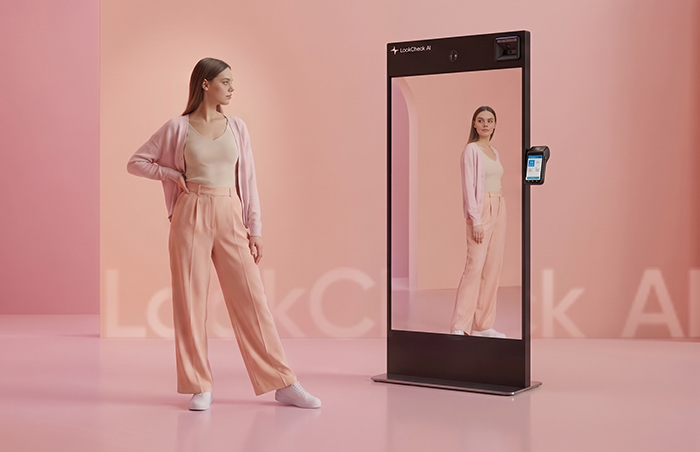
Live deployments, honest limits and the future of fit
The development of this core technology is not happening exclusively in traditional Western tech hubs. Pakistan and the Gulf are currently sitting in a position where this infrastructure gets built locally rather than merely imported. The deep engineering talent required to solve these complex spatial and visual problems exists here, creating solutions tailored for the specific demands of high-volume retail. We are actively demonstrating this capability at Textile Asia 2026 in Lahore.
This technological shift is not a theoretical exercise scheduled for the next decade. Live deployments provide the concrete evidence that precise measurement is already altering the retail landscape. LookCheck is currently live with major brands like Breakout, Mushq and Siiine. In the UK bespoke tailoring sector, Alex Rose has been online for over a year, and the client describes the installation as transformational. The technology is actively functioning in complex, demanding retail environments today.
There are still honest limits to what spatial measurement covers. Visual try-on spans garments including unstitched fabrics, footwear, hats, eyewear and accessories, allowing for multi-category outfit building. Sizing precision, however, requires distinct volumetric models that do not yet apply universally to every conceivable item. It is a methodical, calculated expansion. We build from what we can measure today.
The fashion retail industry was built on the fundamental assumption that a certain degree of guesswork was unavoidable. That assumption is no longer technically valid. We now possess the capability to treat apparel with the exact same dimensional rigour as any other consumer product. The brands that choose to continue relying on ambiguous letters and estimated fits will find themselves competing against brands that provide their shoppers with absolute certainty. In any market, certainty always wins.
ISO 27001:2022 Certified Architecture
LookCheck operates under strict zero-retention policies. In-store images are encrypted, processed in memory, and immediately deleted without saving or using them for training. Read our security practices.
LookCheck in store
Planning an in-store install?
Explore the Smart Mirror, then plan your floor space and rollout with our team.
Explore the Smart MirrorRelated articles

I did not start my career in a boardroom. I started behind a screen, writing code and building systems that actually worked. In those early days, struggles were constant with late nights, broken builds, and moments where the vision felt out of reach. But as a builder, you quickly learn that every point of friction is an invitation to engineer a better solution.